A "New" Tree for Michigan: The Pink Birch Groves of Bete Grise
- Nate Martineau
- Dec 7, 2025
- 10 min read


It was the 27th of November, and the Keweenaw Peninsula had just received its first blizzard of the winter. The cabin in which my family was staying had regained its power a few hours earlier, but it had yet to be plowed out of the more than two feet of snow which had fallen in the previous 36 hours. Luckily the amount of powder was of no concern to Anna's Subaru Outback, which had already braved our inadvisable decision to drive it through 170 miles of blizzard conditions on dark rural highways the night before. It had driven through slush, then ice, then ever-increasing amounts of snow. We'd made right turn after right turn, further removing ourselves from the driving conditions most people would tolerate, until we arrived at the head of the driveway. We dug out a parking spot on the shoulder of Bete Grise Road - safely out of the way of snowplows - and then trudged our belongings to the cabin and met everyone else, who had wisely arrived the night before. The next morning, the car was ready to take us around Lac La Belle to a very special spot on the other side of the Mendota Canal. We left the parking lot for the Bete Grise Wetlands Preserve and headed toward the crashing waves of Lake Superior.
The beach here carries great appeal, with its storied "singing sands" and impressive views of rugged escarpments to the northeast. My favorite shoreline feature is the wave-tossed coal which can always be found scattered among other beach stones - cargo of the wooden steamer Langham, which caught fire and sank into Bete Grise Bay over 115 years ago.

For me, though, the real hallowed ground here is in the narrow strip of boreal forest between the parking lot and the singing sands. I have visited this place in every season, and each time the experience is remarkably similar. The edge of the woodland at the parking lot greets me with familiar vegetation: White Spruce, White Pine, Balsam Poplar, Paper Birch. As I head east into the woods, a mess of downed logs demands that I focus my gaze downward. When I am able to look up, I have entered a seemingly new world where the white forms of the Paper Birches (Betula papyrifera) have given way to a dense stand of shaggy pink tree trunks. These grow at oftentimes odd angles, providing strong contrast to the needle-straight trunks of the spruces and pines. It is a striking scene completely unlike anything else in the state of Michigan, found only in the area stretching from Traverse Bay to the tip of the Keweenaw Peninsula. The crooked pink trunks are those of the Heartleaf Birch (Betula cordifolia): one of many unusual plants found at the tip of the Keweenaw Peninsula and certainly one of the most charismatic.


Left and middle: Northern Paintbrush (Castilleja septentrionalis) and Heartleaf Arnica (Arnica cordifolia). The former is a Western and Arctic plant disjunct to bedrock lakeshores on the Keweenaw's north shore. The latter is a striking western disjunct which grows in rocky woods just inland from the same shorelines.
Right: A stunted Heartleaf Birch (Betula cordifolia) growing on a conglomerate lakeshore west of Copper Harbor. The species makes do but is not happiest here; similar forms can be found on the windy peak of Washington Mountain, New Hampshire.
I will discuss the birches more later, but it is worth noting that the Keweenaw is well known for having some of the densest concentrations of rare plants in the state. Surrounded by Lake Superior on three sides, the land mass reaches toward the freshwater sea's interior, where the surface is very slow to warm in the spring and remains cold throughout the summer. During the growing season, the orientation of the tip of the Keweenaw ensures that prevailing winds are significantly cooled by Lake Superior before passing over the peninsula. These effects are most pronounced directly along the lakeshore. There, additional processes such as wave action and ice scouring make growing conditions even more frigid and the growing season that much more abbreviated. Together, these conditions create the perfect situation for rare plants which prefer the cool temperatures and short summers of high latitudes or high elevations. Such plants are often at the very southern end of their range or disjunct (separated) from populations in either the Intermountain West or subarctic regions. Plant disjunctions are extreme in some cases, with Ceanothus sanguineus being the most jaw-dropping example.
The area where these cooling effects are most pronounced is the bedrock lakeshores and immediately adjacent ridges along the north- and east-facing shoreline of the peninsula. This pattern is nicely illustrated by iNaturalist observations of Northern Paintbrush (Castilleja septentrionalis):

However, this is not the distribution seen in large populations of Heartleaf Birch. While small populations and stunted individuals are found along the north side, the species favors the south shore. The groves of shaggy pink trunks pick up essentially where the paintbrush leaves off and follow the maritime forests down the shoreline and beyond the bottom of the picture, petering out somewhere between the hamlets of Betsy and Traverse Bay. Betula cordifolia seems to thrive best along the somewhat calmer shores here, protected from the gales which cause violent wind and wave action along the north shore every late autumn. Being situated on sand dunes or on thin soils above bedrock, these forests are still subject to high disturbance in the form of blowdowns. As an early successional (i.e. disturbance-dependent) species, these canopy openings are needed to maintain large populations. Overall, while B. cordifolia does not rely on the extremely harsh conditions found on the other side of the peninsula, it does appreciate the cool, humid conditions and high disturbance that Lake Superior provides year-round.

Windfalls are very important in maintaining the large groves of Betula cordifolia at the tip of the Keweenaw, as the species relies heavily on disturbance for successful reproduction.
There is another major difference between Heartleaf Birch and the rest of the Keweenaw's rare plants. It is not disjunct from a range farther to the north or west, nor is it at the southern end of a more northern range. Instead, its range reaches west to Lake Superior from the heart of its range in the northeastern states and maritime provinces of eastern Canada. I don't know of any other plant with this particular distribution, though I wouldn't be surprised to learn I'm overlooking a few. In any case, it is present along much of Lake Superior's North Shore, making its presence in the Keweenaw Peninsula unsurprising.
So, this tree is visually quite distinctive, at least in the form it commonly takes on the shores of the Keweenaw Peninsula. The species' occurrence there also fits a known pattern of distribution. It may therefore be surprising to hear that it is not currently accepted as a member of Michigan's native flora. Here is what Michigan Flora has to say in its account for Paper Birch (Betula papyrifera):
Plants variously referred to B. cordifolia . . . have been regularly reported from Michigan. Betula cordifolia is evidently a northern diploid element . . . in contrast to typical B. papyrifera. It may be that some trees from northern Michigan are the diploid, but all material we have seen seems to fit best within the variable B. papyrifera.
My take here is that Michigan botanists have long been confused and/or misinformed about how to identify B. cordifolia and have therefore been misidentifying it for almost as long as botanists have been collecting there. Somewhere in the midst of that confusion, a botanical authority decided that all Michigan plants were most likely not Heartleaf Birch, and that idea has stuck ever since. Which is how we got into this situation, where stunning pink trees on the shores of the Keweenaw Peninsula are assumed to be a species which they clearly aren't.

The ultimate goal of this blog post is to provide documentation of where these trees grow and evidence that they are, indeed, B. cordifolia. With that in mind, here is my detailed consideration of its occurrence in Michigan:
Betula cordifolia is scattered to locally common at the tip of the Keweenaw Peninsula, beyond approximately Eagle River on the north side and Traverse Bay on the south side. Large groves occur in cold, humid microclimates and habitats with strong northern affinity, particularly dune-and-swale systems and boreal forests along Lake Superior. Scattered trees may be found in peatlands with strong influence from Lake Superior; in ravines, around rock outcrops, or at the bases of cliffs; or as stunted individuals on bedrock lakeshores. The species has also been documented at a select few sites away from the Keweenaw Peninsula, all on volcanic rock in Marquette County. This includes the cool ravines of the Michigamme Highlands, the granite glades northwest of Marquette, and some possible individuals on volcanic lakeshores at Wetmore Landing. The species is therefore expected to inhabit cold, humid microclimates in other parts of the western Upper Peninsula, including the Porcupine Mountains, Trap Hills, and Huron Mountains. B. cordifolia is a rare tree with highly specific habitat requirements away from the Keweenaw Peninsula. As such, potential records in other regions should be reviewed carefully, especially if located away from Lake Superior. Convincing records have not been seen from the Lower Peninsula or the eastern Upper Peninsula.
Now let's take a look at some more pictures from the Bete Grise site, enjoying the sights of the pink birch grove while learning what makes these trees Heartleaf Birches. The differences that set B. cordifolia apart from B. papyrifera are:
Brownish-pink bark on mature individuals. The bark of B. cordifolia also peels more thinly, more abundantly, and in larger, "shaggier" sheets than B. papyrifera. Bark may be whiter and less shredding in younger or more stunted individuals, but it does generally have a pinkish hue when a layer of outer bark is peeled back. The color and texture of the bark may be variable on some mature trees, but when fully developed, they are instantly recognizable even from some distance.




Cordate (heart-shaped) leaf bases on mature individuals. This character is reliable in mature B. cordifolia, with few if any leaves lacking cordate bases. Importantly, cordate bases are also seen on saplings, seedlings, and stressed leaves of B. papyrifera, and may be the cause of the longstanding confusion regarding this species in Michigan. However, Paper Birch has hairy twigs, fewer veins, and different toothing as discussed below. These characters are generally more pronounced when immature or stressed, helping to alleviate confusion. On mature trees, it can be helpful to flatten out a few leaves. B. papyrifera can often appear to have cordate leaf bases when its leaves are slightly folded along the midvein. When flattened out, it becomes apparent that the bases are actually truncate or cuneate.


Single serration on mature leaves. The teeth on leaves of B. cordifolia are essentially all the same size. B. papyrifera nearly always shows distinct double-serration, where smaller teeth are superimposed on larger ones - leading to a more "jagged" outline. This feature is usually exaggerated on immature individuals of B. papyrifera, and generally absent or quite subtle even on immature B. cordifolia. But in general, it is not recommended to try to identify B. cordifolia solely using immature material. Below are mature leaves of B. papyrifera (left) and B. cordifolia (right), clearly displaying the toothing patterns typical of each species.

More lateral veins on each side of the midvein. B. papyrifera often has less than 9 veins per side. B. cordifolia often has more than 9. However, it is annoyingly frequent for either one to have exactly 9 per side. After a while, you do pick up on the subtle tendency for the veins of B. cordifolia to appear more crowded together, regardless of the number of veins - but I do not like relying on vibes for ID. In the case that most leaves have exactly 9 veins per side, it is best to resort to other ID features. And yes, do count the teeny tiny veins near the tip of the leaf.


Hairless or nearly hairless twigs. The smallest twigs of B. papyrifera are usually quite hairy, while young twigs of B. cordifolia are almost always hairless, or occasionally just slightly hairy. However, I have found that some individuals of Paper Birch have glabrous (hairless) twigs. So this is more of a supporting feature: if the current year's twigs are densely hairy, you can eliminate B. cordifolia. If the current year's twigs are hairless, you can't eliminate B. papyrifera without considering other characters.


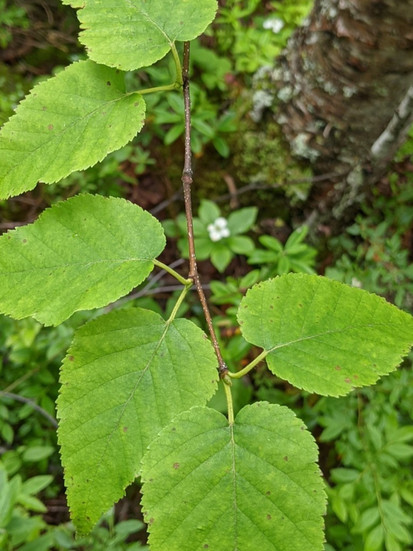


Lenticel size. The birch key for Flora of the Southeastern US reports that the lenticels (pale spots) on young twigs are larger in Heartleaf Birch, with a minimum width of 1 millimeter; supposedly B. papyrifera has a minimum width of 0.25 millimeters. The lenticels are indeed a good visual clue: I have noticed that they look larger and more abundant on shoots and young twigs of B. cordifolia. I have never resorted to measuring lenticels, but I suspect that if you looked hard enough, you could probably find some measuring less than 1 mm even on the world's most perfect Heartleaf Birch.
Smaller maximum size. B. cordifolia apparently reaches a much smaller size in Michigan, although I am not sure about other parts of its range. I have only seen it as a small tree, never more than a foot in diameter. B. papyrifera has the ability to get much larger, although it often doesn't. This may simply be a result of Heartleaf Birch thriving in areas with constant disturbance, and therefore rarely or never achieving a large size.

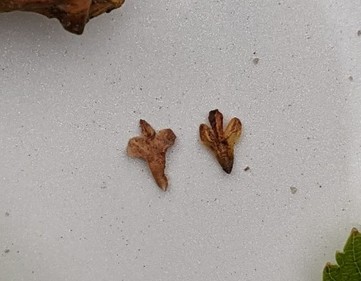
Now for what I find to be the most distinctive character: the scales of female catkins. The female "cones" consist of tiny seeds and firm scales that look like miniature bird feet. We are interested in the scales, specifically the lateral lobes (the two on the sides). In B. cordifolia, they have parallel sides and are angled upward toward the top of the scale, creating distinct sinuses between themselves and the central lobe. In B. papyrifera the lateral lobes are broad and angled 90 degrees away from the central lobe, creating a much different outline more similar to a cross. Flora of the Southeastern US says there is a difference in the size of these scales, with B. cordifolia having larger ones. So far, I've found the shapes so distinctive that I've never thought to test this. Below, there are examples of scales from B. cordifolia at left and center. On the right is a comparison between B. papyrifera (left) and B. cordifolia (right).



So, there you have it - a "new" tree for the state of Michigan. By now these populations are known by a number of Michigan botanists, but it's obviously been at the tip of the Keweenaw Peninsula for thousands of years. At some point in the past, a botanist or three may have even applied the correct Latin name to the beautiful pink birch groves at Bete Grise. It's my hope that this post provides some clarity and inspires someone to deposit a few specimens at an herbarium. This species deserves to be officially recognized as a distinctive part of Michigan's flora.


Not only are you a plant genius … you write so damn well. Happy Holdays my friend.. Will buy dinner, beer, or both the next time you are in Marquette.
Thanks for all the well organized detail with illustrations in distinguishing B. cordifolia from papyrifera. Now I know what to look for!
Glad to see you posting! :-)
I mean, that bark alone has almost got to be enough! Gorgeous. Great write up!
She's iconic 💖
Impressive review!